

Student Computing Clusters
New Media Station Documentation - Importing from Analog Cameras and Other Video Sources
Using the Miglia Director's Cut Take2 analog to digital converter, you can import video from any analog video source into iMovie for editing. This may be an older camcorder or any other video playback device that can output video and audio signals using standard RCA jacks. Remember that digital video files are big and that importing video takes as long as the duration of the video itself. If you have to capture a half-hour long video, it will take 30 minutes to play the tape from start to end and import it.
To reduce wear and tear on the equipment and to keep the system ready for other users, please do not disconnect the existing cables between the VCR and the Director's Cut Take2 converter to connect your own equipment. We intentionally purchased VCR's with front panel input jacks to allow other video sources to be connected to the converter via the VCR.
Import Process
Open iMovie. You will be automatically asked if you want to create a new project or open an existing one.
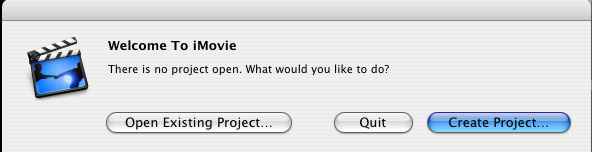
If you are continuing work on a project, select Open Existing Project and use the file dialog to locate your saved project.
If you are starting a new project, click Create Project and proceed through the following steps to save your project to the local computer. Important: Do not just accept the defaults and click Save or press Return. The default choice will save your project to your network home directory which will not have enough space to create an iMovie project. iMovie will crash, and you will have problems with your e-mail and other uses of your account!
- Click the down arrow to the right of the Save As: field in the Save sheet that appears. This will expand the Save sheet to give more options.
- Navigate to the /Temporary Storage folder on the hard drive. To do so, select the local hard drive named System in the column at the far left. Then, select the Temporary Storage folder.
- At this point, enter the name of your project in the Save As: field and click the Save button.

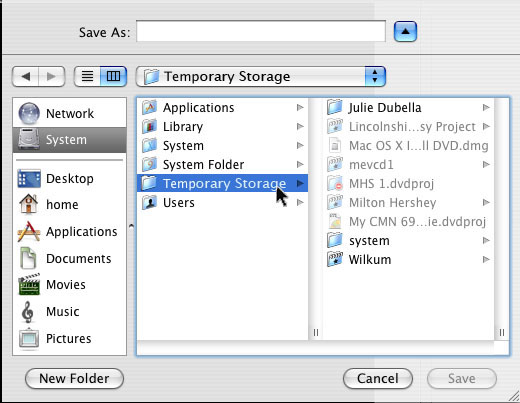

Your project is now saved on the local hard drive of the computer you are using. Note that you will have to return to this specific computer if you stop work on your project and wish to resume at a later date. Only this one machine has your files!
- Put iMovie into Camera Mode using the Camera mode/Edit
mode toggle switch below the iMovie monitor.
You should see a blue screen with the message Camera Detected. If not, make sure that the Director's Cut box is powered on and connected to the computer via the Firewire cord.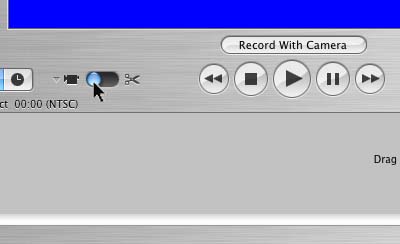
- Connect your video source (camcorder, etc) to the Line In 1 RCA jacks on the front of the Samsung VCR. Be sure to connect video to the yellow one and right and left audio to the red and white jacks, respectively. The connections or cables on your device are likely color coded the same way. Insert your tape or do whatever else is necessary to make the video source ready.
- Make sure that the VCR's Output System is set to NTSC using the stack of 6 buttons to the right of the VCR's tape slot. (Note: You can also work in PAL format within iMovie, if that is what you want for your final product, but for projects intended for use in this country, NTSC is the right choice.)
- Set the VCR to channel L1, for Line In 1, using the channel up and down buttons on the VCR.
- Click the Play button in iMovie. You should see the display from
your video source in the iMovie monitor.
iMovie cannot control your device so you must use its own controls to fast forward, rewind, and play to, for example, cue the tape to the beginning of your material using the iMovie monitor as a display.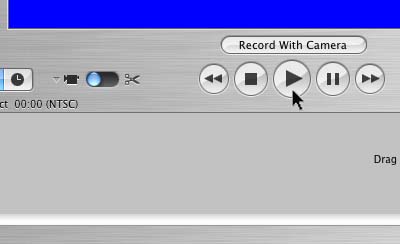
- When the tape is cued properly, click the Import button below the
iMovie monitor in iMovie and then start the video playing on your device.
 This may capture some noise or unwanted blue screen at the start of your
click, but you can edit that our later. It is best to actually start
capturing 5 to 10 second before the actual beginning of your clip for
the best quality.
This may capture some noise or unwanted blue screen at the start of your
click, but you can edit that our later. It is best to actually start
capturing 5 to 10 second before the actual beginning of your clip for
the best quality. - Control the importing process using the Import button. Click it
again to stop importing. Note that your video source will keep
playing. If you click Import again, it will create a new clip in the
Clips pane at the right. In the picture below, there are five clips in
the Clips pane.
You may need to rewind or fast forward your tape using the controls, if you do not have pauses between your separate clips. You can also choose to capture your entire video at once and plan to cut it into sections later.
- When finished, stop the playback on your video source, and switch iMovie to Edit mode.
